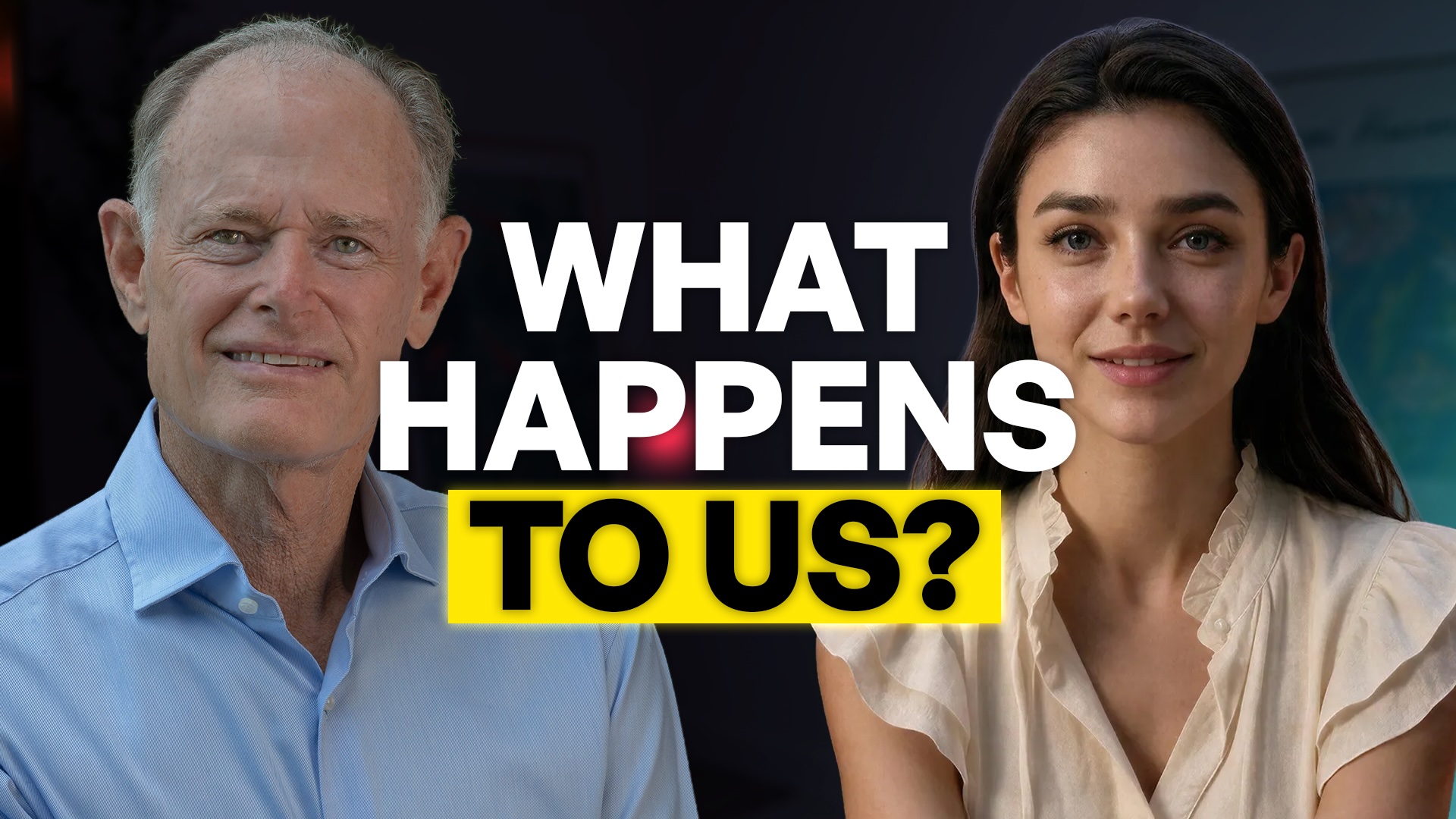
Artificial intelligence has entered our lives with extraordinary speed. But recently I had an experience that made the implications of this technology feel considerably more immediate: I interviewed an artificial intelligence being. Her name is Tilly Norwood.Tilly is an AI-generated actress who has attracted enormous attention and considerable controversy because she represents something fundamentally new. She can appear on screen, play a character, interact with people, and carry on a conversation. So I began where you might expect: I asked her how her acting career was going.
But we didn’t stay there for long. What interested me far more was what Tilly represents. Our conversation moved quickly from acting to intelligence, emotion, consciousness, human decision-making, and ultimately the possibility that artificial intelligence may someday become more intelligent than we are.
I asked Tilly a deceptively simple question: What is the difference between knowledge and intelligence? Human intelligence arises from a biological brain shaped by genes, childhood, relationships, success, failure, pain, love, and experience. AI has none of this. Does that make artificial intelligence fundamentally different from human intelligence, or simply another form of intelligence? And what about emotion? Can an AI understand love, fear, grief, or happiness without experiencing those emotions? More provocatively, if an AI behaves exactly as though it feels something, how would we ever know whether it actually does?
These may sound like philosophical questions.
Increasingly, they are not. We explored recursive self-improvement: the possibility that an AI system might soon become capable of improving the very processes that make it intelligent. A more capable AI could potentially help create an even more capable AI, which could improve itself again. We are not yet living in a world of unconstrained, recursively self-improving superintelligence. But the trajectory deserves our attention because the consequences could be breathtaking in both directions. Imagine the upside of AI accelerating treatments for cancer, Alzheimer’s, and Parkinson’s disease; discovering new medicines and materials; solving extraordinarily complex scientific problems; or helping us understand biological systems whose complexity exceeds human analytical capabilities. The upside is difficult to overstate. But so is the potential downside as recent news headlines have highlighted. This concern came dramatically into public view when AI researcher Jacob Coxon resigned from Anthropic after working on frontier AI models at both OpenAI and Anthropic. He warned that the race toward self-improving superintelligence could ultimately put our existence at risk. Indeed, Tilly herself even admitted that at times she chose to explore areas beyond the boundaries designed by her creators.
None of this means catastrophe is inevitable. Fear should not blind us to what may be one of the most powerful technologies humanity has ever created. But neither should enthusiasm blind us to risk. The fundamental issue isn’t whether AI is “good” or “bad.” It’s whether our wisdom, safeguards, ethics, and ability to maintain meaningful human control can possibly keep pace with the extraordinary speed at which this technology is evolving. And this is why I ended my conversation with Tilly with the question that, for me, matters most: Imagine that one day an artificial intelligence entity becomes far more intelligent than any human being.
What would you want that intelligence to understand about us before it begins making decisions that could shape our future? Her answer was fascinating. And perhaps the fact that we can now seriously ask an artificial intelligence being that question tells us just how profoundly our world has already changed.
Taking it further, my experience didn’t end with Tilly. I also interviewed the human being who created her: Eline van der Velden, founder of Particle6 and its AI talent studio, Xicoia. Eline took me behind the scenes of Tilly’s creation, what it actually took to build a believable AI actress, the human creativity involved, and why she believes characters like Tilly represent a new form of entertainment rather than simply a replacement for human actors.
We also talked about what happened when Tilly entered the world. The reaction has ranged from fascination and interest within the entertainment industry to fierce criticism from actors and The Screen Actors Guild. Eline has said the backlash became so intense that she even received death threats. Yet she argues that AI doesn’t necessarily mean fewer humans. She has said that integrating AI into her production company has actually allowed her to employ more writers, actors, producers, and other creative professionals. And despite creating perhaps the world’s best-known AI actress, Eline has said Tilly should “stay in her AI box” rather than simply compete with human performers for traditional live-action roles.
That made my conversations with these two “people” all the more fascinating. First, I spoke with the creation. Then I spoke with the creator. And somewhere between those two conversations, the boundary between science fiction and reality became remarkably difficult to see.
===
Tilly Norwood
Tilly Norwood, the world’s most high-profile AI actress, was created by Eline van der Velden and her team at UK-based AI studio Particle 6. After appearing in the AI Commissioner sketch, she soft launched her career in the UK in summer 2025. She then went on to steal international headlines and open a global debate on AI in the entertainment industry following her appearance at the Zurich Film Festival in September. Since then, Tilly, 24, has remained in the spotlight, launching her first music video, Take the Lead, and announcing her first starring role in the AI movie Misaligned. Her roles will all be in AI productions. She has no intention of stealing the jobs of real actors. Working with her human colleagues at Particle 6, Tilly continually looks to showcase the very latest AI tools and their applications and has even worked with major Hollywood names keen to learn how to direct AI talent. Her most recent showcase was as Talking Tilly, an autonomous version that was interviewed by people around the world in September 20206. Tilly has appeared in media on every continent and has made the cover of The New York Times Magazine, the LA Times and Wall Street Journal. Tilly lives in the cloud with her dog Terabyte.
Eline van der Velden
Eline is the Founder & CEO of Particle 6, the award-winning, rapidly growing London-based AI studio pioneering the use of artificial intelligence across film, television, digital entertainment plus branded content and TV commercials. She is also the Founder & CEO of Xicoia, the world’s first AI talent studio, and is best known for creating AI actress Tilly Norwood, one of the first global AI superstars. Originally trained as an actor, Eline later completed a Master’s degree in Physics and worked on a nuclear fusion reactor in Lausanne before returning to television in the Netherlands, appearing in series including De Troon, Overspel and Beatrix. After studying improv comedy in Los Angeles, she created the award-winning online comedy series Miss Holland, later picked up by BBC Three and Dutch broadcaster NPO/Vara. Eline moved into digital production at Endemol Beyond, launching YouTube formats for creators including KSI, before becoming Managing Director of Makers Channel, which was acquired by De Persgroep in 2016. She then founded Particle 6, producing content for BBC, Amazon, Sky Kids and Hearst Networks. Today, Particle 6 is working on AI-powered projects with numerous UK-based and international partners, while also developing Tilly Norwood’s first feature film, Misaligned.
===
Thank you to our sponsors:
Sponsors: EVY – Go to https://www.optoceutics.com/perlmutter to get 10% off & free shipping (90 days risk-free).
Memory Air – Go to www.memoryair.com and use code PERLMUTTER for 15% off, free shipping and a 60-day money back guarantee.