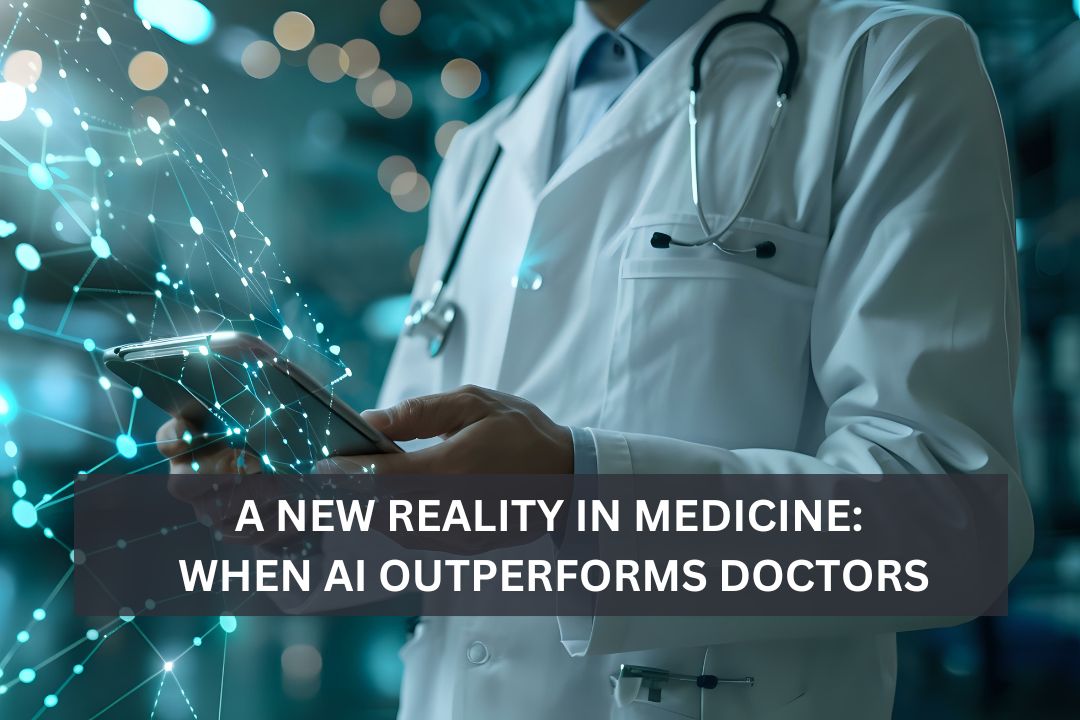
For as long as I’ve been in medicine, I’ve been fascinated by what it really means to think like a physician, not just recall facts, but reason through uncertainty. That has always been our gold standard. But a new study in Science.org made me pause. It evaluated a modern large language model against hundreds of physicians on real clinical tasks like diagnosis, test selection, management decisions, even emergency room cases. And the result?
The AI didn’t just perform well, it outperformed physicians across nearly every category.
This wasn’t trivia. It was real, hands-on, medicine. The model generated more accurate differential diagnoses, chose better next steps, and in the emergency department, where decisions are fast and information is limited, it actually pulled ahead of experienced clinicians. That’s a moment. Not because machines are replacing doctors, but because something fundamental has changed. We are now dealing with technology that can reason under uncertainty, something we’ve long believed was uniquely human.
Think about this in another context. Not long ago, the idea of getting into a driverless car felt unsafe, even unthinkable. Today, the data increasingly show that autonomous driving systems can outperform human drivers in many settings. At some point, we have to reconcile our intuition and sentiment with reality. And that’s exactly where we are right now in medicine.
This doesn’t diminish the role of the physician. Medicine is far more than cognition, it’s empathy, connection, judgment, and context. But it does mean we are no longer asking whether AI can perform at a high level. That question has now been answered. The question we must ask is how we integrate it responsibly.
If we get this right, we can reduce diagnostic errors, improve access to care, and elevate outcomes in ways we’ve never seen before. If we resist it, we risk holding onto an outdated model simply because it feels more comfortable.
We have to accept this new reality. Not blindly, but thoughtfully. The physician of the future won’t be replaced, but they will be augmented. And in that partnership lies one of the most powerful opportunities in modern medicine.